Tuesday, 18 August 2020

Did you ever get to ride on this?

First, you'd have to be old enough to remember one of Canada's once famous trains. 

This said, I guess I qualify because I'd just become a teenager and rode these trains over their short route several times during 1967.


The Expo Express was a rapid transit system consisting of five stations and a 3.5 mile route, running from Cité du Havre to La Ronde in Montreal, Quebec, Canada.

Built for the 1967 World's Fair Expo 67 at a cost of around $18 million (CAD), these trains carried 1,000 passengers each and ran approximately every five minutes.

In 1968 the cars were sold to the City of Montreal for $1.8 million and operated by the Montreal Transit Commission. The train remained in service for five more years for Man and His World (summer only); however, from 1969 onward, they ran on a shortened route when the terminus was cut back to Saint Helen's Island. After the 1972 season the service was withdrawn.

Interior of Expo Express train looking toward front

Interior of Expo Express train looking toward rear of car

The Expo Express used standard railway technology, with two running rails and a third electrified rail identical to those of the Toronto subway. In fact, the trains used were a modified version of the Hawker Siddeley H-series used by the Toronto Transit Commission, except with one less door on each side, and streamlined ends. Consequently, unlike Montreal's Metro with rubber tires, the Expo Express used traditional steel-wheeled trains. The Expo Express also featured fully air conditioned passenger cars, whereas Montreal's Metro does not.

The Expo Express was the first fully automated rapid transit system in North America, utilizing an Automatic Train Operation (ATO) system based on audio frequency track circuits furnished by the Union Switch & Signal division of Westinghouse Air Brake Company.

This fact, however, was not widely publicized during the fair, as it was felt the public would not readily board a train controlled entirely by a computer. Operators from Montreal's transit union were placed in cabs at the front and given mundane tasks such as opening and closing the doors of the train to reduce boredom.
 
 
July 1967
 
In 1973, the trains were stored on the Concorde Bridge between Saint Helen's and Notre Dame Islands. The north end of the line was demolished in 1974. In summer 1979 the trains were moved to the Port of Montreal via a temporary track, and stored at the nearby CN Point St-Charles Shops.

After several unrealized schemes including a reported sale to the New Jersey Sports and Exposition Authority, the cars were moved from Point St-Charles to an outdoor field storage facility in Les Cèdres in the mid/late 1980s, and were scrapped in 1995.
 
(Most of this material was taken from Wikipedia)
 
 
 The Oddblock Station Agent


Thursday, 13 August 2020

Back From the Dead?


August 11, 2020

CP: “We’re Back” on the Atlantic Ocean
Written by Andrew Corselli, Managing Editor, Railway Age


Canadian Pacific (CP) officially launched its international intermodal service through the Port of Saint John, N.B. the morning of Aug. 11. The inaugural train carried containers from the Hapag-Lloyd vessel Detroit Express bound for intermodal terminals on the CP network in Canada and the U.S.

CP originated westbound train 251-11 for the Montreal region at Brownville Junction, Maine, with the first Port of Saint John containers on connection from the New Brunswick Southern (NBSR) and Eastern Maine (EMRY) railways. From Montreal, CP will move containers from the vessel Detroit Express on connecting trains to destinations that include Toronto, Winnipeg, Calgary, Edmonton, Vancouver, Chicago and Minneapolis.

The first eastbound intermodal train to the Port of Saint John departed Montreal on Friday, Aug. 7.

CP gained access to the Port of Saint John via its purchase of the Central Maine & Quebec Railway (CMQ), completed in June. CP “has committed to investing $90 million over three years into the CMQ property to enhance safety and efficiency over the corridor. Complementing that investment is the port’s $205 million West Side Modernization project, which includes a new wharf, a terminal upgrade and a deeper shipping channel.”

CP said it anticipates that by year’s end it will be able to offer 24-hour service between Saint John and Montreal.

“The new Port of Saint John service offers shippers a compelling value: a congestion-free port with a world-class operator, matched with CP’s Precision Scheduled Railroading model,” said Keith Creel, CP President and CEO. “CP has been without access to a deep-water Atlantic Ocean port for a quarter-century, and today I’m pleased to deliver a simple message: We’re back.”

“The Port of Saint John connection gives us the rare opportunity to offer shippers a truly new and extremely compelling service to reach North American markets,” said Jonathan Wahba, CP VP Sales and Marketing Intermodal and Automotive. “With a world-class terminal operator in DP World and CP’s investment in the CMQ, our customers will enjoy an unmatched value proposition that will benefit beneficial cargo owners for years to come.”


Footnote:

No caption was provided with the photograph at the top of this post, however the location is undoubtedly the renown railway bridge at Onawa, Maine.

This following image recorded some twenty-six or more years earlier should remove all doubt as to the location.


Monday, 18 May 2020

The Railway to Nowhere


This train is on the way to Nowhere... it truly is.


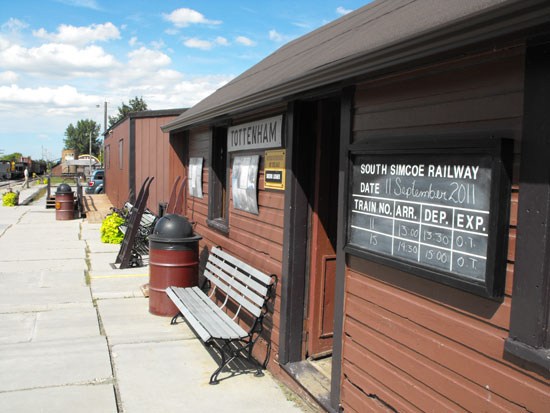
Probably the only sign of evidence confirming the existence of Nowhere.


And one can still buy a ticket to Nowhere...


The generation gaps of train travel are explained here in less than 25 words...


Tottenham is where it all starts these days...


And now... the "Once Upon a Time" section of this post...

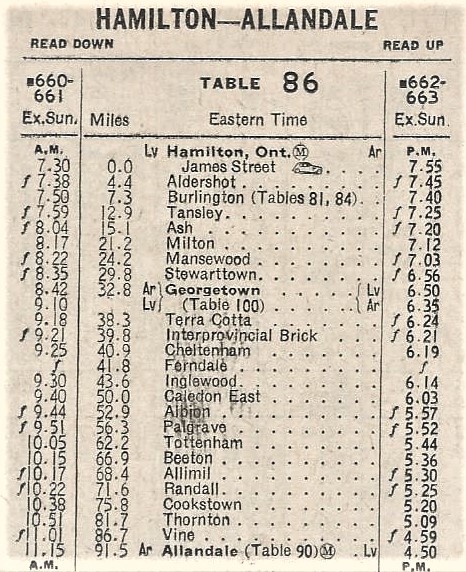
Nowhere was nowhere to be found in the schedule... but Tottenham is.

From CNR's 1959-1960 public schedule


Nonetheless a visual record of one of those trains really does exist online... this image was recorded in 1960.


Although one can no longer ride the rails from Abbey to Zorra via Bagdad today, this far into the 21st century one can still take a train from Tottenham to the middle of Nowhere...


But getting to Tottenham?

You'll have to drive.


The Oddblock Station Agent


Friday, 3 March 2017

Footnotes from the "Department of Useless Information"


CP Rail's Train 40

In my younger years my father used to call me, "The Department of Useless Information" because I could recite details from CP Rail's timetables, details that no one would ever need or want to know. Admittedly at the time that moniker would rankle me, but in hindsight his remark probably reflected an element of fact. 

This posting will do the same; provide useless details that no one needs or wants to know.

For summer 1973 (and subsequent summer seasons in the mid 70's) CP Rail dug Train 40 out of their archives to number The Atlantic Limited, as detailed in the following frame.

Train 40's schedule from CP Rail's April 1974 public timetable


A photo fresh from the internet: this train was identified only as the Atlantic Limited. The recognizable location was Windsor Station in Montreal and given the bright time of day this was likely Train 40 rather than 42.

The original Train 40's schedule as published in CPR's September 1950 public timetable. Unlike in 1973, during the early 1950's, Trains 40 and 42 operated concurrently rather than alternatively.


Not too long ago while looking through an old book, this piece torn from an envelope unexpectedly slipped out from the pages (which eventually prompted this post). The following undated scrap recorded the consist of Train 40 in summer 1973 when I made an after-work Friday evening trip from Montreal to Scotstown.


Recorded during the journey.


Missing from the list: the baggage car and the locomotive unit assigned to haul the train; perhaps one of the two usual E-8's had been given the task but today one can only speculate.

Surprisingly and more than 40 years later, the four former CP Rail stainless steel cars listed above remain in active service on Via Rail's trains today. 2249, the exception, was an Angus-built coach.


This view inside the glass attic was captured by Donald Haskel on CP Rail’s Train 40 when "The Atlantic Limited" was operating on its summer schedule. The scene above was recorded in Montreal on July 07, 1977, just moments prior to the 18:05 departure from Windsor Station. Thank you Mr. Haskel for taking the photograph and sharing it with us.


This July 1971 image records Train 41, the westbound "Atlantic Limited" crossing the St. Lawrence River and minutes away from the first of its three Montreal stops. The Train 40 consist recorded on that paper scrap would have been an almost identical match to this scene illustrated here. (Stan J Smaill photo)


Occasionally CP Rail would issue me a pass using this older Canadian Pacific form.

In June '76, I made my only trip on CP Rail's "Atlantic Limited" as a CP employee; the train was operating on its Train 40 summer schedule. By this time, CP Rail had dropped their train's name from the public timetable.


The Department of Useless Information
a.k.a. The Oddblock Station Agent


Monday, 26 October 2015

A few more CSRR September Musings


A ticket to ride...


41 Years! 

Most of the dot.com and many tech companies didn't last very long, certainly not four decades, so the Conway Scenic Railroad must be doing something right to be around after 41 years.

North Conway, New Hampshire, is well-known for tax free outlet shopping, but for me, the main attraction has always been the trains.

Okay! I'll admit to doing some shopping... after all, who doesn't like a bargain at stores you cannot and will not find north of the border. This said, I still like to ride the trains while the others go shopping at Settler's Green and other places.

Very little seems to change from year to year but on a comfortable, sunny afternoon I still like to spend a few hours wandering around the grounds... which is okay but just keep off the tracks... and record a few images.

As the following two scenes of CSRR252 resplendent in Maine Central colours show, all is very quiet at the station depot and in the yard between train times.


The 11:30 a.m. departure having returned from Bartlett; now accepting passengers and preparing to become the 1:30 p.m. departure to Conway.


A look at the 2015 schedule and train times.


At 1:32 p.m. and with bell ringing, 573 and passenger cars departs southward for Conway, NH.


The run-around as seen from on board - a familiar scene shortly after the train arrives in Bartlett. The markers (lantern displaying the green light) have already been hung in preparation for the return to North Conway.


A night train seconds away from departure at Bartlett a few Septembers earlier.

Next: the Conway Scenic Railroad's Notch Trains visit here in summer and fall, but for most of the year the railway north of Bartlett, NH, remain dormant.

Ben and Catherine in front of the former Maine Central Railroad station at Crawford Notch.


A word to those who may take railroading a little too seriously: don't be so quick to dismiss Thomas that Tank Engine as kid's stuff. 

Most North Americans under 50 have never set foot on a passenger train. Most Canadians under 40 don't know that Canada's two main railways once had their own separate, competing passenger train services. Unless one lives in close proximity to a mainline or branch line, railways today for the most part, are largely invisible and unknown.

Thomas & Friends have introduced several generations of little people to the world of railroads, a world those young people would probably never see or learn about.


The Oddblock Station Agent


Monday, 3 August 2015

A Few Old Train Photo Yarns

What does one do with old railway photos and images that don't quite fit into a category or topic but may have a story behind them nonetheless?

Following are a few thoughts.


1. An introduction


Summer 1974

One memorable warm summer Saturday evening I was to meet up with and join a group at one of those popular restaurants in Gastown. 

With its partly re-cobbled streets, quasi-quaint exotic shops, and unusual eateries with fancier names than their fare, Gastown was that area of refurbished older buildings in what was probably the oldest part of downtown Vancouver. CP Rail was immediately behind the buildings on Water Street.

My cousin Monica had spontaneously organized this outing, inviting any friend and acquaintance she could think of inviting on the spur of the moment, and then she scrambled to make the arrangements. Monica was often arranging last-minute group outings to unusual locations and establishments. Usually invited to tag along, I was grateful to be included. At times I also wondered if she was deliberately trying to introduce me to some of her friends.

Just feet away from the entrance of my intended destination, I unexpectedly noticed a bright red CP Rail diesel sitting in the yard near the foot Carrall Street. My then new Kodak pocket camera was tucked into my pocket so I detoured over to quickly grab this scene of CP 8515. 

No doubt this wasn't the party Monica had schemed for me to meet, however this was the only photo and number I took home that evening.


2. Thanksgiving in Kicking Horse Pass

Mile board 133 of CP Rail's Laggan Sub in October 1974.

October 1974


October 1974, Train 2 departing from Field, BC.
Moments after abandoning the onboard comforts of "The Canadian" at Field, BC, I grabbed this image of CP Rail's departing Train 2 about to commence its assault of the "Big Hill"

Watching that train disappear really did feel like having waved good-bye to the last chance to change my mind about walking up that same hill.

Two hours later at mile board 133, I was in this craggy corner of British Columbia that I had often dreamed about one day visiting. Now truly in the middle of nowhere, I was alone and isolated from everyone except for the people in the cars and trucks that raced by overhead.

This day had certainly arrived but I hadn't expected a cool, damp, overcast October weekend because I had always visualized a warm, sunny, late August summer day. My temporary resting place was beneath the Trans-Canada Highway on the bridge's concrete support footing, a sheltered front row seat facing the famed Canadian Pacific route through Kicking Horse Pass. 

The highway overpass was a perfect location to break my trek, rest and celebrate Thanksgiving Weekend with the special meal I had brought along just for this occasion. My meal consisted of English muffins, cheese slices and a tiny bottle of red wine. To provide some atmosphere of elegance, other than only the scenery, I brought along a few paper cups I had picked up from train's water cooler. At least a paper cup was a step above having to drink out of the bottle. Of course I would've preferred that traditional hot turkey dinner with my family in Montreal''s West Island, which I was certain they would be having this weekend, but I was a little too far away to join them.

After opening the bottle of wine and filling a paper cup, I stretched out and raised my arm then exclaimed aloud, "Here's to you Canada!" and then as an afterthought added aloud, “Here's to you CPR!”


3. Welcome to Field

CP Rail's Train 1 during the 10 minute crew-change stop at Field, BC.

Summer 1975... when we were young and foolish.

At dusk we were unceremoniously awakened by a park ranger who ordered us to pack up and move to one of Yoho Park’s designated campsites; we had camped out beside the main highway. 

Upon inquiring where the nearest site was, we were informed it was several miles back near Leanchoil. Absolutely no way were either Michael or I going to be moved in any direction away from Field so we refused to move our camp. In spite of the ranger's threats to fine us for illegally camping we continued to refuse to be pushed into walking any further in any direction. 

Neither one of us could have walked anyway; our feet were too sore. Relenting somewhat, Michael and I did offer to break camp only if we could have a ride into Field. The park ranger refused and gave us some official excuse about not being allowed to carry passengers in a park vehicle regardless of the fact his girlfriend was sitting in the cab. After a few more minutes of heated argument and our unbending refusal to move, the ranger finally gave in and accepted our terms. He drove us into Field.

Field did not have a hotel or motel but, with some assistance from the park ranger, Michael and I managed to rent a room for the night in the upstairs of the local watering hole. Beyond the door to our room was a single uncovered light bulb in the ceiling, an unshaded window and two beds with bare mattresses. In some way the architectural similarity of the building reminded me of the bedrooms in my grandparents' house. 

"What a dump." Michael complained.

"Looks pretty darn good to me... and clean too." I said, very grateful not to be spending another night outdoors sleeping on top of rocks.

"Eighteen dollars for this? I think you paid too much." he commented.

"This was a bargain Mike. Believe me, in the morning you'll feel differently about this place." I said.

"Which bed do you want?" he asked.

"The nearest one. I can't walk any further." I replied.

Our ordeal was over and I felt like a humiliated survivor rather than a triumphant adventurer. We fell four miles short of our goal but in those two days we had managed to cover on foot at least 31 miles of the 35 miles from Golden, BC. We were probably lucky to be leaving with our bodies and minds intact. 

The following evening we picked up Train 2 for our return to Vancouver.

Our foot journey was a gruelling experience that neither of us would forget and that day would prove to be my last visit on foot into the wilds of the Rockies.


4. Amtrak Days

Abstract from Amtrak's public timetable effective May 15, 1975

November 1975

For a brief time my Saturdays became "Amtrak" days. An Amtrak Day to Seattle was long; four and a half hours of train travel to get there, seven hours there and almost five hours to return. Travelling alone and spending a rainy day in Seattle was depressing. 

Daily I prayed to God and begged for a miracle to change some circumstances (read: floundering LDR) in my life, so that doing crazy things such as going to Seattle to send and receive mail would not be necessary, but nothing changed. I felt as if the louder I shouted toward heaven, the more God seemed to ignore me.

The downpour outside was unrelenting and walking around was not in any way appealing. More than four hours remained until train time and I was wasting those hours in Seattle’s King Street station. A panhandler was shuffling around and searching through the station’s garbage bins. Eventually he stopped in front of me but I did not look up from what I was doing. 

“Do you have any money you can part with?” he asked.

That was a strange way to ask for money because all money was money that could be parted with in one way or another. 

“Here.” I eventually answered and handed him a few dollars, hoping he would go away.

“Thank you.” he replied, sounding somewhat surprised.

Instead of wandering off, the vagrant sat on the bench and began to talk to me. “I haven’t always lived like this.”

I did not say anything. I did not know what to say to him. I did not want to have to say anything to him.

“Where are you from?” he questioned, even though I had remained silent.

“Canada.” I finally answered but trying to avoid a conversation.

“What are you doing down here?” He continued.

"Just visiting from Canada.” I revealed.

“I’m from Mississippi.” He announced.

“What are you doing here?” I asked, aware that Seattle was far from anywhere in Mississippi.

“Couldn’t take it anymore.” He stated, now sounding somewhat agitated.

“Take what?” I wondered.

“All the nonsense, the lies, the crap. I had to get out.” He continued, sounding as if he was repeating to me something that he thought I should have already known.

What he said did not mean anything to me and I did not ask for more details. I really did not want to know any more.

“I quit university.” He added, and then continued, “I’ve been drifting around and trying to find a purpose in life.”

He went on to inform me that his father owned a fishing resort in Kenora, Ontario, and then began to tell me about the resort. He then abruptly stopped and asked, “Have you ever heard of Kenora?”

“Yes, it’s near the Ontario-Manitoba border. CP Rail’s trains roll through there.” I stated authoritatively, certain of this much.

“Yeah, you know it.” He confirmed. 

He then handed me a folded slip of paper with the name and address of that resort in Kenora and while pointing at the paper said, “If you ever visit Kenora, go there and ask for my father. Just tell him I told you to ask for him.”

He wished me well and wandered away and I wondered why he had stopped to talk. I looked at the name and address on the paper and thought, “Why would I ever go to Kenora?”

His comment about quitting university and finding a purpose in life stirred me though and compelled me to question why I was coming here to Seattle every Saturday. 

Desperation was my excuse. But what was my purpose?

From the internet: Amtrak's Pacific International circa 1975


Amtrak’s Pacific International was a four-car train outfitted with worn-out, hand-me-down equipment from Union Pacific and Great Northern. A dome-observation car on the tail end gave the train an air of importance; not every passenger train included a dome car. Unlike CP Rail’s Canadian, which offered coach seating in their dome cars, Amtrak had turned the dome into a dining area and served meals up top. 

During the return trip I sat in the rear of the dome car and from the curved back windows watched the track racing away into darkness. Occasionally I would puff away on my pipe when the lounge area was deserted. As I stared out, my mind wandered aimlessly...

“A smoldering, half-smoked cigarette has been left in the ash tray.” Holmes pointed out after making a cursory inspection of the immediate area.

“Is this a clue?” Watson asked.

“No.” Holmes responded immediately, having already dismissed the cigarette as irrelevant.

“What makes you so certain?” Watson challenged.

“Left by a woman, you will observe smudges of lipstick on the end.” Holmes pointed out.

“Ah... yes... but what if our quarry's not alone?” Watson suggested.

“The young lady who left this here was quite alone.” Holmes replied.

“How do you know?” Watson questioned.

“We passed her only moments earlier but you most likely looked at her rather than observe her. She was wearing the same shade of lipstick, slightly smudged as if by…” Holmes started to explain.

“A cigarette against the lips.” Watson interjected.

“Exactly!” Holmes stated, almost sounding like a teacher who had been explaining the solution of a problem to a student.

A yell came from the galley, abruptly awakening me from my daydream. 

“What? Another murder?” I asked aloud mindlessly.

“No. Cook fried some fingers on the griddle.” The Amtrak steward replied, having heard my silly question.

A half-smoked cigarette in the ash tray on the empty adjacent table was still smoldering away, and sure enough traces of lipstick were visible; but I couldn’t recall who may have been sitting there moments earlier.

After 41 days without mail the strike ended and Canada’s postal services resumed. Two weeks later I made my final trip to Seattle to close the mailbox and hopefully, to find a letter or two.


The Oddblock Station Agent

Tuesday, 19 May 2015

More Railway Ramblings...About Trains of Course!


Just call me the imposter

When Kie took this photo, a few people who saw thought I was the engineer. Although I insisted I was only another passenger like everyone else, I was asked to be in a couple photos posing as the engineer.

Once in a while it is nice to dream and wonder what life would have been like had I been able to make a career of moving trains over roads of wood and steel. The passing of time ensures that some desires of youth never come to pass. Today I am too old to become a railroader - but at any age, I can occasionally wonder what life on railway may have been like.

Need anything be added about the scene below? Perhaps a few words. The location of course is Agawa Canyon. This scene was recorded before CN bought the ailing Algoma Central Railway.


Agawa Canyon, August 17, 1997. The locomotives had already completed their runaround and the idle southbound train was holding on main line while passengers tour the canyon.


Oh no! Not another F unit!

This scene was recorded in summer 1998. 6520 was leading the Waterloo-St. Jacobs Railway's 1950's streamliner which just squealing to a stop at Farmer's Market station to take on two passengers - the writer and the writer's poor wife who took this photograph.

Only an hour's drive from home and operating from April through December, this train was easy to get to and very easy to ride. A $10.00 ticket was good for unlimited all day travel at the breathtaking maximum speed of 15 miles per hour; this was no ordinary streamliner. The train was truly a joy to ride - comfortable reclining seats, large picture windows, air conditioning, snack service and nice scenery. What else could a train rider ask for? 

I spent many hours on this train enjoying the slow lane of life.


6508 is on the other end of the train

With an F-unit on each end, the Waterloo-St. Jacobs Railway's passenger train was similar to a push-pull operation. This negated the need to turn the engine or run the engine around the train upon the completion of each run.

 
Using former passenger equipment that CNR newly placed into service when it introduced the "Super Continental" in the 1950's, the Waterloo-St. Jacobs Railway utilized an accurate and almost identical paint scheme.

 
A look at the advertised train service


The South Simcoe Railway actually has a station named NOWHERE which is an intermediate station marked by a sign, but the Waterloo-St. Jacobs Railway's train literally terminated in the middle of nowhere after crossing the Conestogo River; somewhere, or nowhere, in the midst of farm fields between two country roads. I'm assuming their northern terminal was too small and too remote to have a station name board.


Looking northward. The resting train is in front of the Waterloo station during the 40 minute break before the day's last run to St. Jacobs is made. 6508 will be on the rear when the train departs northward.

A day trip to the Waterloo-St. Jacobs Railway was definitely worth the drive. While Kie shopped at the farmer's market, I rode the train. 

Although the train operated during 1999, because I rode the trains that year too, so far as I am aware, the railway and its train never made it into the 21st century. 

Following the demise of the Waterloo-St. Jacobs Railway, the idle equipment spent years sitting in Mimico Yard and was visible to riders on the Lakeshore West GO Trains.


A Little closer to home...

Actually a lot closer to home. This next group of images was taken two decades ago at Ellengale Park; a five-minute walk from home.

If one is patient enough to wait long enough, something eventually shows up.

Winter is probably the best time to take train photos. A heavy snow fall usually flattens most of the dead vegetation growth, and the absence of foliage provides clearer views. The downside of course is the cold, the wind and fewer hours of daylight. Then again, some days are just right and become worth the waiting.


CP 5660 and unidentified SOO Line mate were heading west near mile 17 of CP Rail's Galt Sub. Although winter, not much snow was on the ground this Sunday afternoon.


A few hints of green herald an early spring.


April 12, 1993. A late afternoon westbound GO Train slowing for its stop at Erindale station.


The Roadrailer was an interesting train with the most unusual equipment to ride on rails. 

How often does one see a train without railcars; instead only highway trailers with their tires skimming just a few inches above the rails? 

Unlike Red Rose Tea's Canadian claim to fame, Roadrailer trailers are no longer seen moving over Canadian railways north of the border like this. Pity.


Note:
I have since been corrected. The Roadrailer train is alive and well, moving on CN Rail into Toronto. 

The following post on You Tube published June 24, 2014, by TheEtobocokeRailfan, features the Roadrailer trains passing through Bramalea.


Later summer 1993 in Mississauga saw the westbound Roadrailer quickly passing through ON CP Rail and heading to Detroit, Michigan for hand-off to Nortfolk Southern.


Freight trains are frequent on the Galt Sub but photographing the trains requires a fair amount of just plain waiting... and waiting... and so on. Actually more time is spent track watching.

GO Trains are easy to photograph because they operate on fixed schedules. The disincentive is that the GO Trains all look alike except for the numbering.


May 21, 1993 evening sees GO F59PH numbered 527 operating on the rear and about to arrive in Erindale.


Carload traffic

This scene should serve as a reminder why railways exist and why railways continue to exist; hauling freight and getting paid to accomplish the feat profitably. But scenes of single carloads of freight waiting to move have all but disappeared, because handling shipments like this gets in the way of running trains.

Railways are in business to haul freight and moving trains is simply the result of having freight to haul. All revenue rail cars eventually have to originate a load somewhere, whether it's a busy intermodal terminal or rusting team track with a single flat car.


Scene recorded at Dorval, Quebec, in the mid 1980's. An observant eye may have noted that the large crates on each and of the flat car as well as the upper crate in the center, are all over-width.


This loaded flatcar no doubt will require special attention to ensure that the route the car is to travel is wide enough to clear the crates. If not, then damage may result.

Before this car is permitted to move, CP Rail will send someone out to check the manner in which the load was placed on the flat car, tied down and blocked to prevent shifting. If the preparation work has not been carried out to the inspector's satisfaction, then more materials may have to be added.

This said, does it make sense to send this shipment on a flatcar that may require several days or weeks to travel to destination when the cargo could move on a truck or two and get to that destination in a day or two?

I wonder what was in those crates and where this car was destined to.


The Oddblock Station Agent